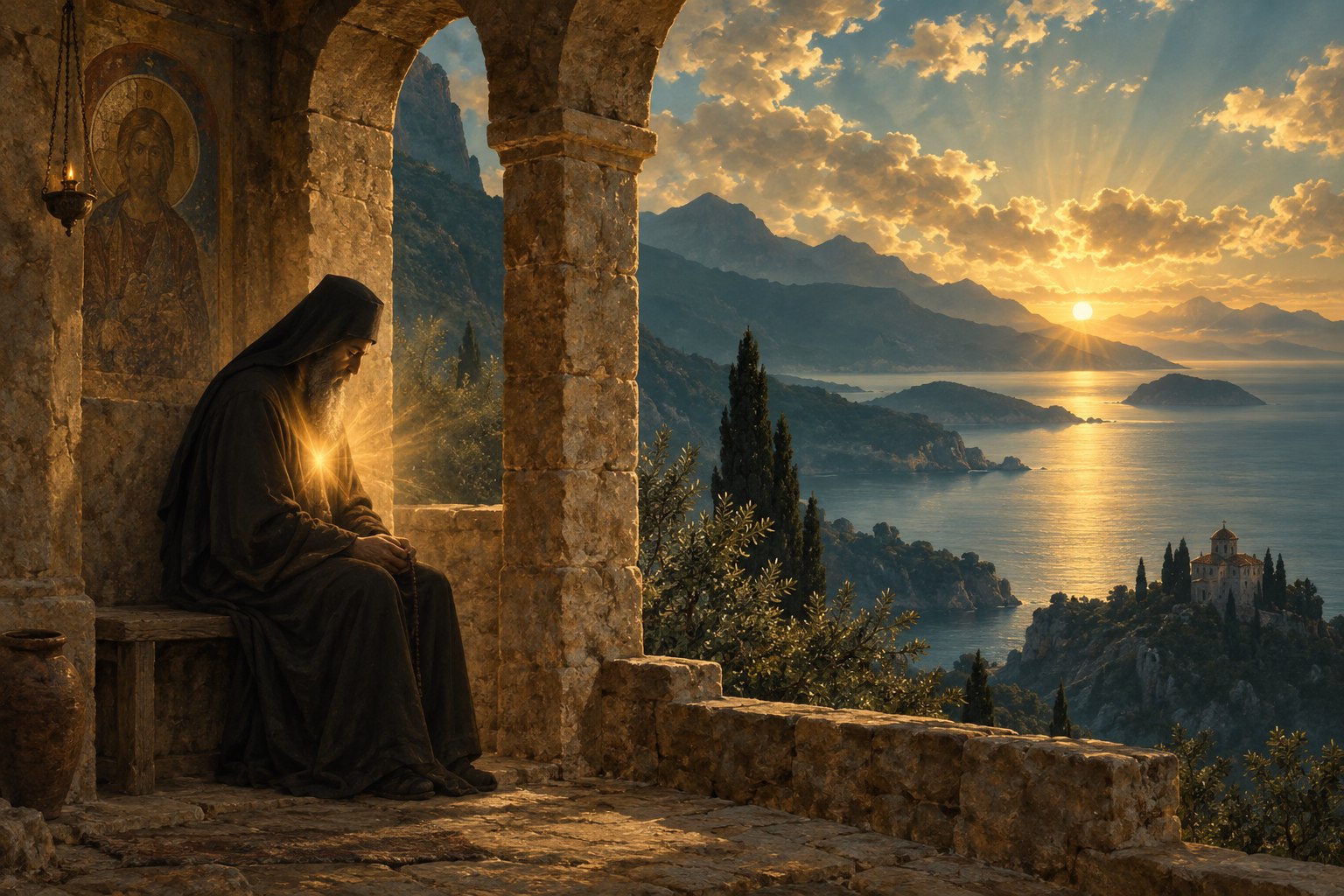
Contemplative traditions · Stillness & divine light
Explore Hesychasm and Theosis through the prayer of the heart, the teachings of Gregory Palamas and the contemplative image of divine light.
Explore this article
- Introduction: The Cosmic Crisis Of Separation
- 1. Historical Context: The Battle For Direct Realization
- 2. Theological Foundations: Essence Vs. Energies
- 3. The Methodology: The Practice Of Hesychasm
- 4. The Manifestation: The Taboric Light
- 5. The Reality Of Participation: Experiential Vs. Metaphorical
- 6. The Destination: Theosis And Cosmic Transfiguration
- Conclusion: The Chosen Path
- References
Introduction: The Cosmic Crisis Of Separation
Humanity lives in a state of profound psychological and spiritual fracture. From the moment a human being develops self-consciousness, a deep optical illusion takes root in the mind. We look out at the physical world and see ourselves as isolated entities. We point to our physical body, our thoughts, our cultural labels, and our personal memories, and we say, “This is who I am.” This is the birth of the ego—the birth of the illusion of absolute separation. Underneath this frantic mental noise, a quiet, ancient ache remains. We feel lonely. We feel anxious. We sense a deep dislocation from our Source. We wonder why existence feels so heavy, and we ask the ultimate human question: How do we return to absolute union with the Living God?
For the Western world, theology has frequently become an intellectual exercise. It has been reduced to academic arguments, structural dogmas, and moral codes. God is often viewed as a distant, cosmic King sitting outside His creation, watching humanity from afar. In this view, salvation is merely a legal transaction—a passport to an afterlife to escape punishment. But inside the ancient, mystical heart of Eastern Christianity, a completely different model of reality has been preserved for thousands of years. This path is not an intellectual metaphor. It is not an emotional sentiment. It is a direct, experiential methodology designed to completely dismantle the false separate ego and saturate human nature with the uncreated life of God.
This journey is known as Theosis (deification or divinization). It is the radical process where a human being becomes, by grace, everything that God is by nature. At the absolute core of this path is the practice of Hesychasm—a precise methodology of silent prayer, physical breath anchoring, and intense internal guarding of the mind. Through this purification, the mystic does not merely think about God; they literally, objectively behold the Taboric Light. This is the uncreated energy of the Divine, identical to the brilliant light that enveloped Jesus Christ during the Transfiguration on Mount Tabor. This essay will explore the historical battles, the theological mechanics, the practical methodology, and the ultimate unitive destination of this ancient path to awakening in God.
1. Historical Context: The Battle For Direct Realization
To understand the absolute reality of this mystical path, we must examine the fierce fourteenth-century theological war that threatened to destroy it. The battle took place in Byzantium, centered on the holy mountain of Mount Athos. The conflict arose between two radically opposing models of reality: the intellectual scholasticism of Barlaam the Calabrian, and the direct, experiential mysticism of Saint Gregory Palamas.
Barlaam was a highly educated Western monk from Italy. He was deeply steeped in Aristotelian logic and scholastic philosophy. Barlaam argued that God is completely unknowable and utterly inaccessible to human experience. He claimed that because God is transcendent and infinite, human beings can only know God indirectly through the physical creation or through the dead letters of Scripture. To Barlaam, any monk who claimed to see God or physically experience the Divine presence was a heretic or a victim of severe psychological delusion. He openly mocked the monks of Mount Athos, calling them omphalopsychoi—men whose souls were in their navels—because of their physical posture during silent prayer.
Saint Gregory Palamas, a brilliant monk and theologian of Mount Athos, rose to defend the direct experience of the mystics. Palamas understood that if Barlaam was right, humanity was doomed to permanent, irreversible isolation from God. If God could only be known through intellectual concepts, then religion was just a house of cards built out of human thoughts. Palamas fought back by grounding his defense in the continuous, living tradition of the Eastern saints. He argued that God is indeed completely unknowable in His hidden essence, but completely, dynamically knowable in His uncreated energies.
The victory of Gregory Palamas at the Councils of Constantinople in 1341 and 1351 was a monumental turning point for Christian mysticism. It firmly established that human beings are not trapped behind a wall of biological or intellectual separation. Direct realization of the Divine is possible. The Councils confirmed that the light seen by the quiet monks of Mount Athos was not an optical illusion, an emotional projection, or a created physical light. It was the objective, uncreated radiance of God Himself.
2. Theological Foundations: Essence Vs. Energies
The absolute foundation of Gregory Palamas’s defense relies on a critical distinction: the difference between the Essence (Ousia) and the Energies (Energeiai) of God. This distinction is the theological key that allows humanity to become one with God without destroying the unique identity of either the Creator or the creation.
The Essence (Ousia)
Utterly hidden · Inaccessible · Transcendent void
Breathes out
The Energies (Energeiai)
Fully manifest · Accessible · Uncreated light
God in His Essence is completely, utterly transcendent. The Divine Essence is the hidden, infinite void that no human mind can ever penetrate, categorize, or perceive. In His Essence, God is beyond being, beyond consciousness, and beyond existence itself. If a human soul were to merge directly with the Essence of God, the soul would be completely obliterated, dissolved out of existence like a single drop of water falling into a furnace. In His Essence, God remains forever unique, lonely, and inaccessible.
However, God does not remain trapped inside His Essence. Out of absolute, unconditional love, God continuously breathes Himself out into the physical universe through His uncreated Energies. These energies are not something separate from God; they are God Himself in His outward manifestation, His activity, and His self-knowing presence. Just as the sun remains safely out in space in its central body (essence), it fully communicates its actual heat and light to the Earth through its rays (energies). When you stand in a ray of sunlight, you are physically, literally touching the sun.
This means that everything in the universe is sustained by the uncreated energies of God. The creation is not a collection of dead objects made by a distant cosmic engineer. The universe is formed within God, out of God, and for God. His uncreated energies penetrate every single atom, every grain of sand, every leaf of a tree, and every cell of your physical body. It is the dynamic power that keeps the physical matrix from collapsing back into absolute nothingness. To experience the uncreated energies is to experience the direct, living presence of the Almighty.
3. The Methodology: The Practice Of Hesychasm
To behold this divine reality, the seeker cannot rely on ordinary human thinking. The human mind is dominated by the ego, which operates through three frantic internal voices: background static, active planning, and constant internal self-talk. The ego lives entirely on a timeline of past and future, and it uses labels to wrap reality in a veil of words. To hear the still, small voice of God, the mind must be brought into absolute, unmoving silence. This is the practice of Hesychasm, a word derived from the Greek hesychia, meaning stillness, quietness, and deep internal peace.
Hesychasm is a precise, psycho-physical methodology developed by the desert fathers over centuries to silence the mental chatter and return the awareness to the heart. It consists of three primary, practical anchors:
The Jesus Prayer
The hesychast does not use complex intellectual arguments or long, wordy prayers. They use a single, rhythmic phrase as an anchor for attention: “Lord Jesus Christ, Son of God, have mercy on me.” This prayer is repeated thousands of times until it drops out of the analytical brain and enters the subconscious mind. It becomes like a gentle background hum, driving out the random static of the ego. The prayer strips away the labels, clearing the mental landscape for direct perception.
The Breath Anchor
The monks discovered a profound psychological truth: you cannot be fully aware of the physical sensation of breathing and think a frantic, anxious thought at the exact same time. They explicitly synchronized the Jesus Prayer with the natural rhythm of the lungs. On the inhalation, the monk silently prays: “Lord Jesus Christ, Son of God.” On the exhalation, they pray: “Have mercy on me.” By anchoring the awareness tightly to the physical breath, the plug is pulled from the ego’s power source. The mind is forced to stand still in the present moment.
The Guarding of the Heart (Nepsis)
The most crucial movement of Hesychasm is the inward turning of the attention. Barlaam mocked the monks for looking at their navels, but the physical posture of tucking the chin down was simply a practical tool to lower the gaze and drive the attention inward. The monk practices nepsis—absolute watchfulness.
Instead of continually asking, “What external things am I experiencing right now?”, the mystic shifts their attention back toward the Knower. They watch the threshold of the mind. The moment a random thought, label, or memory appears on the screen of consciousness, they do not fight it or follow it. They immediately apply the prayer, drop the label, and return to the deep, silent stillness of the heart.
4. The Manifestation: The Taboric Light
When the human mind is completely purified of its frantic chatter, a radical perceptual breakthrough occurs. The monk does not merely experience an emotional sentiment of peace, nor do they contemplate an intellectual metaphor. They begin to behold a literal, objective manifestation of the Taboric Light.
The Divine Energies
The Taboric Light
Beheld by the purified eye of spirit
Human soul · Deified / saturated
This light is the exact same radiance that enveloped Jesus Christ on Mount Tabor during His Transfiguration, as recorded in the Gospels of Matthew, Mark, and Luke. When Peter, James, and John fell to the ground on that mountain, they were not looking at a physical fire, an optical illusion, or a created flash of lightning. Christ did not change on that mountain; rather, the spiritual eyes of the disciples were temporarily opened to see the uncreated, divine radiance that was always shining inside the temple of His physical form.
The Taboric Light is the physical and spiritual manifestation of God’s uncreated energies. It is a light that is paradoxically both luminous and completely distinct from physical light. Physical light can be measured by human science; it is made of photons, travels at a specific speed, and belongs to the 0.0035% spectrum of visible reality. The Taboric Light, however, is completely uncreated. It does not casting a shadow. It does not burn the skin. It does not belong to the material matrix.
To behold the Taboric Light requires the awakening of the Nous—the highest faculty of the human soul, often called the “eye of the heart” or the “spirit.” The ordinary physical eyes can only see physical objects, and the analytical mind can only understand thoughts. But when the three voices of the ego are completely silenced through Hesychasm, the Nous wakes up. The purified eye of the spirit looks inward and beholds the literal brilliance of God’s presence radiating within the internal temple. It is the objective, physical, and spiritual verification that the illusion of separation has completely collapsed.
5. The Reality Of Participation: Experiential Vs. Metaphorical
It is vital to stress that in the Eastern mystical tradition, this experience is completely real, physical, and objective. It is not an intellectual metaphor. It is not a psychological archetype. It is not an emotional state of hyper-suggestibility or hysteria.
When the Western scholastic models look at mysticism, they frequently reduce it to subjective emotional experiences. They claim that when a saint says they are “one with God,” they are simply feeling a deep emotional high, or using poetic language to describe a psychological state of calm. Western theology often warns that a physical creature can never truly participate in the actual life of God because the ontological gap between the Creator and the creature is absolute.
But the Hesychast tradition completely rejects this limitation. Through the uncreated energies, human participation in the Divine life is completely literal. Saint Macarius the Great wrote that just as fire penetrates an iron bar until the iron itself looks like fire, glows like fire, and radiates heat like fire—while still remaining iron—so does the Holy Spirit completely penetrate the physical human body and soul.
Your eyes become the eyes through which God looks out at His creation. Your hands become the hands through which He blesses. Your physical body is completely floating within His awareness, and His uncreated light fills every single cell of your flesh. It is an experiential reality. The mystic stands in the center of the room and knows, with absolute, unshakeable certainty, that their separate, lonely identity has been undone, and that they are physically and spiritually saturated by the living presence of the Almighty.
6. The Destination: Theosis And Cosmic Transfiguration
This absolute saturation of human nature by the uncreated energies leads to the ultimate destination of the spiritual journey: Theosis (deification or divinization). Saint Athanasius the Great laid down the supreme blueprint for this reality in the fourth century: “God became man so that man might become God.”
Human nature: iron bar
+
Divine energies: fire
Saturated through Hesychia
Deified humanity
The bar glows, radiates heat, and acts identically to fire, yet retains the true substance of iron.
Theosis is the final collapse of the apparent separation between God and self. It is the realization that the individual consciousness by which you know you exist is not an independent source. It is a temporary expression, a localized focalization, of the greater Divine Awareness. You discover that the separate ego you spent your entire life trying to protect, defend, and validate was a total optical illusion—a false house of cards built out of thoughts.
When a human being achieves Theosis, they do not become God in His hidden Essence. They do not become an independent Creator of new universes. Rather, they become God by participation. Every movement of their mind, every breath of their lungs, and every action of their body flows smoothly from the deep, unmoving stillness of the Divine Center. The seeker discovers a beautiful, timeless truth: the one who was searching for God was itself appearing within that which it was seeking. The drop has not simply been lost in the ocean; it has discovered that it is the ocean in a localized form.
Furthermore, Theosis is never an isolated, selfish event. It has a massive, cosmic consequence. When a single human being awakens to this unitive state, they do not just change themselves—they change the frequency of the entire physical matrix around them. Their presence alone holds the balance for everyone in the room. Through them, the uncreated light of Mount Tabor ripples outward into the gray, frantic marketplace of the world. They become a living beacon of light in a dark room, holding the frequency of absolute peace and proving that humanity was never, ever meant to live in lonely isolation from its Source.
Conclusion: The Chosen Path
The practice of Hesychasm and the direct realization of the Taboric Light stand as a timeless, universal invitation to every human being who is tired of the ego’s noise. You do not need to remain trapped inside the three frantic voices of your mind. You do not need to live as an isolated, anxious entity, fighting to survive in a cold material universe.
The blueprint has been walked and proven for thousands of years by the quiet mystics of the East. By turning your attention away from your thoughts and directing it entirely toward the Knower, you can step through the golden doorway of awakening. You can drop the heavy burden of who you think you are. You can let the uncreated energies of the Holy Spirit saturate your body and mind until the mask of separation completely dissolves into thin air. Be bold, be encouraged, and rest in the beautiful, unitive reality that you and the vast Ocean of Love are eternally one.
References
- Athanasius of Alexandria. On the Incarnation. London: Mowbray, 1953. (Reference for the classical patristic blueprint of Theosis: “God became man so that man might become God.”)
- Gregory Palamas. The Triads. Edited by John Meyendorff. New York: Paulist Press, 1983. (The primary theological framework for the absolute distinction between the unknowable Divine Essence and the fully accessible Uncreated Energies, along with the objective reality of the Taboric Light.)
- John of the Cross. The Ascent of Mount Carmel. Translated by E. Allison Peers. Garden City, NY: Image Books, 1958. (Comparative reference for the structural three-part mystical progression: Purgative, Illuminative, and Unitive paths.)
- Lossky, Vladimir. The Mystical Theology of the Eastern Church. London: James Clarke & Co., 1957. (Comprehensive historical and analytical reference unpacking the dogmatic connection between Hesychasm, Palamite theology, and the experiential process of Theosis.)
- Macarius the Great. The Fifty Spiritual Homilies. Translated by A. J. Mason. London: SPCK, 1921. (The foundational metaphorical source comparing the total saturation of human nature by the Holy Spirit to fire completely penetrating an iron bar.)
- Meyendorff, John. A Study of Gregory Palamas. London: Faith Press, 1964. (Detailed historical documentation covering the fourteenth-century hesychast controversy, the Councils of Constantinople, and the battles between Barlaam and Palamas.)
- The Philokalia: The Complete Text. Compiled by St. Nikodemos of the Holy Mountain and St. Makarios of Corinth. Translated by G. E. H. Palmer, Philip Sherrard, and Kallistos Ware. 4 vols. London: Faber and Faber, 1979–1995. (The definitive experiential text layout and practical instructional manual outlining the psycho-physical methodology of Hesychasm, watchfulness, and the Jesus Prayer.)
- Ware, Kallistos. The Orthodox Way. Crestwood, NY: St. Vladimir’s Seminary Press, 1979. (Accessible textual reference simplifying the universal application of Eastern Christian mysticism, the concept of the Nous, and the omnipresent nature of the Divine.)